

Weightlifting Articles
Key Elements Of a Strong & Stable Split Jerk Receive
Missed jerks often aren’t a strength issue, they’re a positioning issue.
You can dip harder, drive faster, and tell yourself you just need more leg power, but if the bar meets a weak receive position, none of that ends up mattering.
If you want consistent jerks under load, the receive has to make sense mechanically.
This article breaks down the key elements of a split jerk receive that actually hold up when the bar gets heavy.
Author: Adam Johnston
Reading Time: 6 to 7 mins
Date: 22nd January 2026
Tags: #Training #Strongman #SplitJerk #OlympicLifting #TechniqueMatters
Key Points:
Bar stacked over the base of the neck
Bar inline with the back of the wrist
Front knee over the ankle with the shin vertical
Back knee bent and slightly behind the hip
Even 50/50 weight distribution between feet
On the ball of the back foot
Feet around hip-width, not tightrope narrow
Feet pointed straight ahead or slightly in
These positions aren’t aesthetic preferences. They’re the best way to stack joints, manage force, and give yourself the best and safest chance of making the lift.
Upper Body
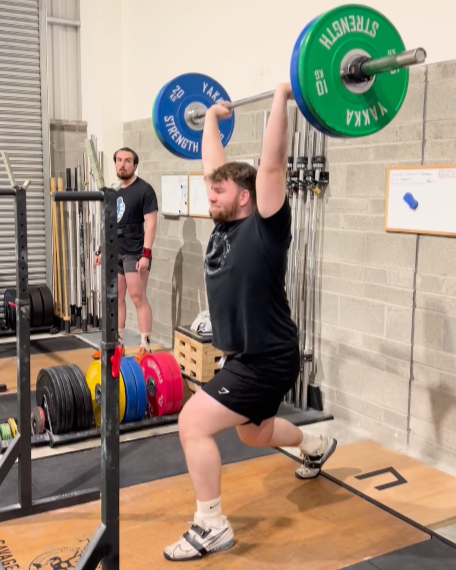
Bar over the base of the neck
When the bar is received overhead, it should sit over the base of the neck. This keeps the bar directly over your centre of mass and allows your skeleton and upper back musculature to carry the load instead of your shoulders and lower back.
If the bar is forward, you’ll chase it.
If it’s too far back, you’ll overextend and lose stability.
Bar inline with the back of the wrist
Your wrist position tells you a lot about what’s happening upstream. When the bar, wrist, elbow, and shoulder are stacked, force transfers cleanly into the floor. When the wrist is overly extended, you lose that stack the stacking of joints creating instability and increase injury risk in the wrist if done long term.
This isn’t about forcing a straight wrist. It’s about lining things up so they don’t have to work harder than necessary.
Lower Body
Front knee over the ankle & shin vertical
The front leg is your brake. A knee that’s stacked over the ankle with a vertical shin lets you absorb force without collapsing or drifting forward. If the knee shoots too far forward, you’ll put excess force through the knee and lose the ability to recover front foot first.
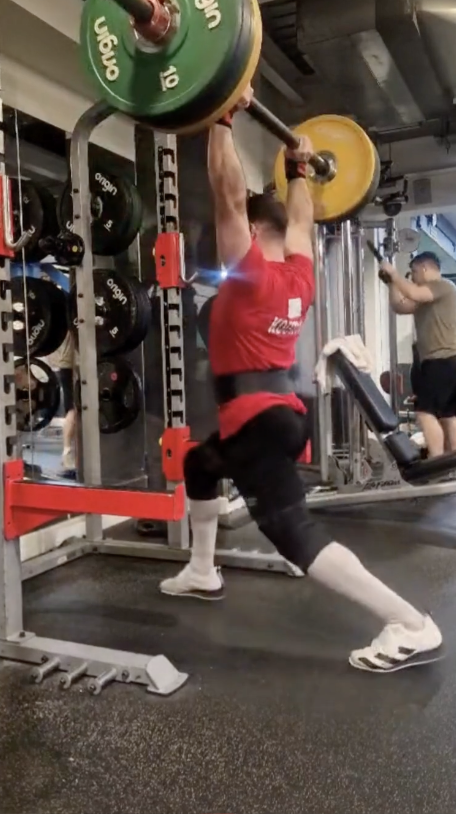
Back knee bent and slightly behind the hip
A locked back leg kills your ability to absorb force. A back knee that’s bent and sitting just behind the hip gives you a suspension. It lets you settle into the receive rather than slamming into it.
This bend also keeps your hips under the bar, which is non-negotiable if you want consistency under heavy loads.
Back foot on the ball of the foot
The back foot should be on the ball of the foot, not flat. This allows the ankle and knee to contribute to force absorption and keeps the hips mobile enough to adjust if the bar isn’t perfectly placed.
A flat back foot often turns into a locked leg, which removes your margin for error.
Base Of Support
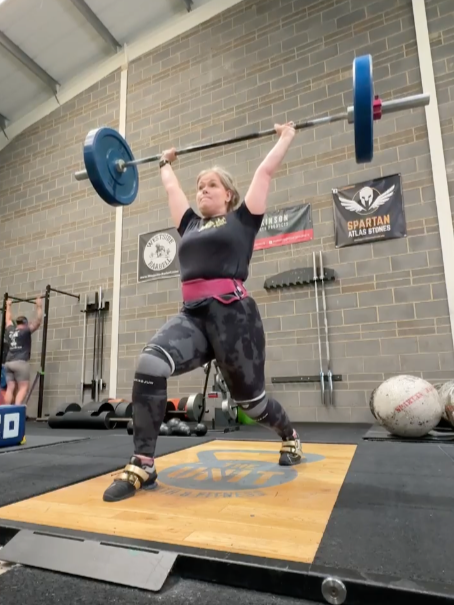
Feet around hip width, not too narrow
A split stance that’s too narrow looks tidy but performs badly. You want enough width to create lateral stability and to do that, you ideally need to be at a width that prevents you hips from moving outside of your base of support.
Hip-width is a good starting point. From there, your structure and comfort should dictate the final adjustment.
Feet straight ahead or slightly in
Feet turned out in the split usually leads you your hips rotating like a helicopter and where the hips go, the upper body will follow.
Keeping the feet straight or pointed slightly ‘toe in’ keeps the hips inline and you stable without fighting any extra rotational forces while keeping your adductors safe.
About 50/50 weight distribution
This is where a lot of lifters go wrong. Too much weight forward and you’ll chase the the bar. Too much back and you’ll struggle to recover.
An even weight distribution between the feet gives you stability and balance and if you haven’t noticed already, thats what this whole article has been about.
It lets both legs do their job and keeps the bar centred over your base of support.
Practical Application & Takeaways / How to Run It
You don’t need to overhaul your jerk overnight. You just need to audit it.
Start by filming your jerks from the side and the front. Pause the video in the receiving position and check each element one at a time to see what’s actually happening versus what you think is happening.
Pick one element to focus on per session because trying to fix everything at once usually fixes nothing and fixing one thing will often have a knock on effect to something else.
Use sub-maximal weights where you can still move with intent. Heavy enough to matter, light enough to feel positions.
If you’re training strongman, remember that logs and dumbbells don’t change the principles. The shapes change, but the receive still lives or dies on stacked joints, even weight distribution, and the ability to absorb force.
Final Thoughts
The split jerk receive isn’t complicated, but it is unforgiving if you get it wrong.
You don’t need more cues. You need better positions. When the bar is stacked, your feet are organised, and both legs are doing the right things, the jerk stops feeling chaotic and starts feeling predictable.
Predictable is repeatable and repeatable is progress.
Get the receive right and the jerk stops being something you survive and starts being something you own.

About the author
Adam is a strength coach and the Head Coach of Savage Strength.
He helps lifters get brutally strong through simple, effective training with a speciality in Olympic Weightlifting and Strongman.
If you want coaching tailored to you and your goals, let’s get started with personalised programming designed to get you stronger.